From ‘Gut Feelings’ to Graphs… Data for Empowered Parents!
“Data turns concerns into evidence—and evidence drives meaningful change.”
If there’s one thing I’ve learned both as an educator and as a parent navigating special education, it’s this: we cannot rely on “gut feelings” to determine whether our children are making meaningful progress. Progress in an IEP is not about how things seem—it’s about what can be clearly, consistently, and objectively measured. That’s where the shift from gut feelings to graphs becomes so powerful. When goals are written well and data is collected with intention, families and teams can move beyond vague statements like “he’s doing better” and instead say, “he is now completing this skill with 80% accuracy and only one prompt across three settings.” That level of clarity changes everything—not just for understanding progress, but for making informed decisions about instruction, services, and supports.
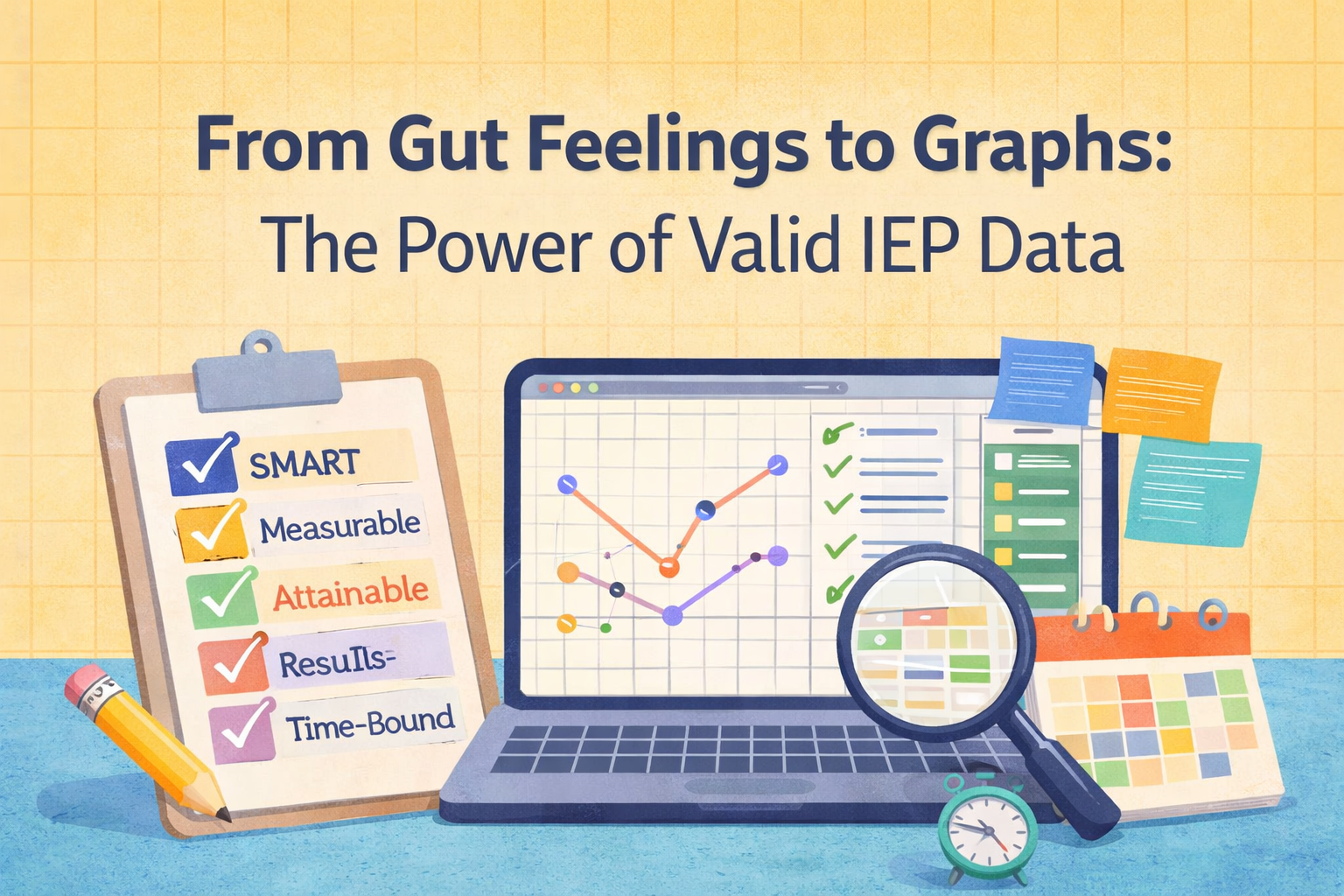
The foundation of meaningful data starts with the goals themselves. If a goal is not written using SMART criteria—Specific, Measurable, Attainable, Results-oriented, and Time-bound—then it is nearly impossible to track progress with any level of validity . For example, a goal like “will improve social skills” may sound appropriate, but it lacks the specificity and measurability needed to determine whether growth is actually occurring. In contrast, a well-written goal defines exactly what the student will do, under what conditions, how often, and how success will be measured. Without that clarity, any data collected is inherently unreliable because it is not tied to a clearly defined skill or outcome. In other words, if the target is unclear, the data will be too.
Equally important is understanding what kind of data should be collected. Not all progress looks the same, and different skills require different types of measurement. Academic skills might be tracked through accuracy and independence, while behavior goals may require frequency, duration, or latency data . Executive functioning skills might be better understood through prompt levels or task completion rates, and social-emotional goals often benefit from tracking replacement behaviors or patterns using ABC (Antecedent-Behavior-Consequence) data. When teams choose the right type of data for the right skill, they are far more likely to capture an accurate picture of student performance. This is what creates valid data—data that actually reflects what is happening, rather than a partial or misleading snapshot.
Validity in progress monitoring is critical because it directly impacts decision-making. If data is inconsistent, subjective, or poorly aligned to the goal, teams may incorrectly assume a student is making progress—or not making progress—when the opposite is true. This can lead to inappropriate changes (or lack of changes) in services, supports, or placement. Under IDEA, schools are required to ensure that students are making meaningful progress, and when they are not, the IEP must be revised. But without valid data, it becomes incredibly difficult for families to advocate effectively or for teams to respond appropriately. This is why collecting your own data, asking questions about how the school is measuring progress, and ensuring goals are written clearly are not just “nice to have”—they are essential tools for protecting your child’s right to a free and appropriate public education.
Ultimately, moving from gut feelings to graphs is about empowerment. When parents and teams use clear goals and valid data, they can identify patterns, spot plateaus, and make informed, proactive decisions rather than waiting for problems to escalate. It allows everyone at the table to speak the same language—one grounded in evidence rather than assumption. And most importantly, it ensures that our children are not just present in their educational programs, but are truly making meaningful, measurable progress toward their fullest potential.